Best Sleep Tracker: Smart Ring vs Smartwatch Compared
Rings and watches both track your nights, but they suit different sleepers. Here is how comfort, battery and accuracy really compare before you buy.

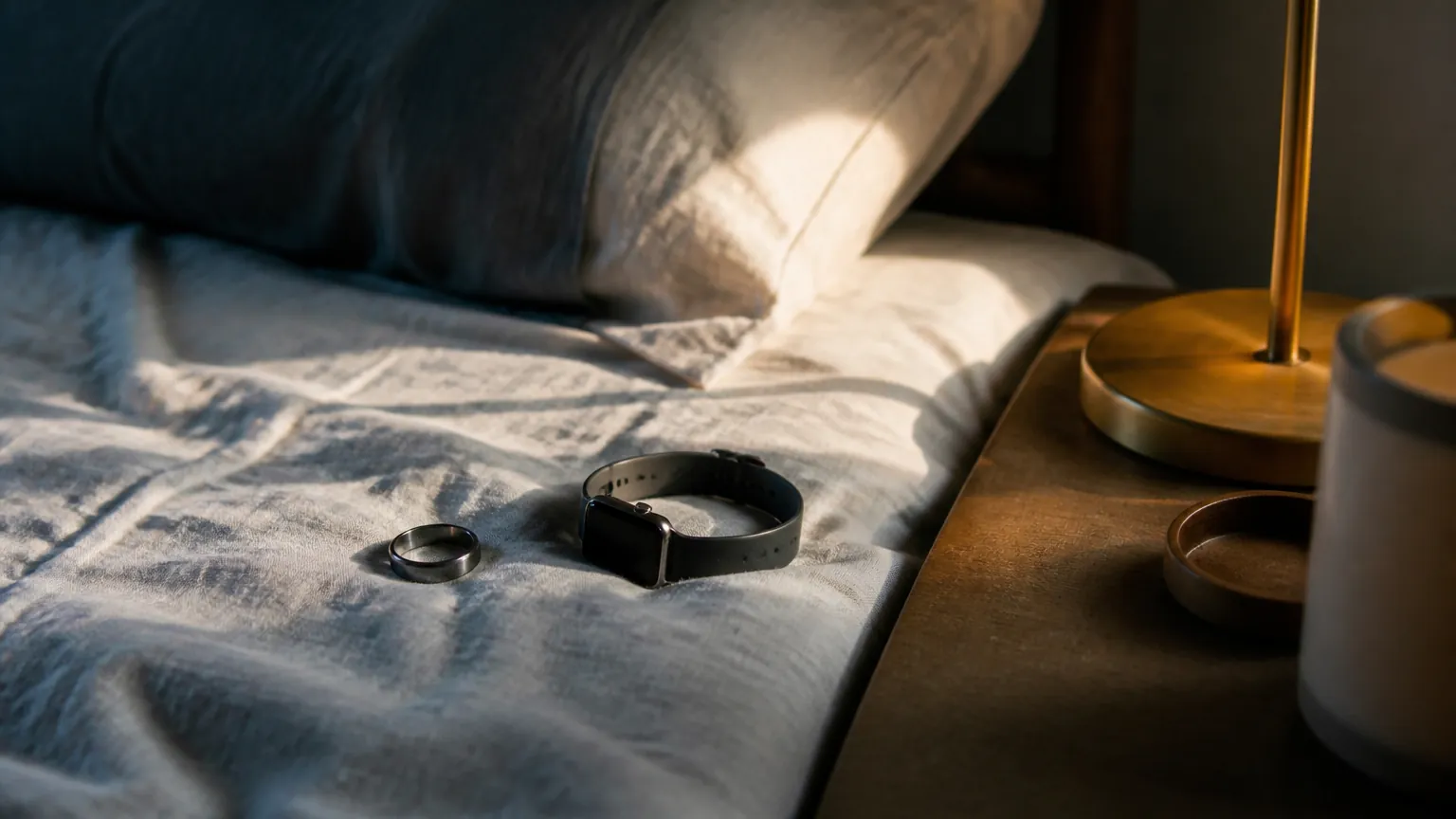
If you want to understand your nights, the search for the best sleep tracker usually comes down to a simple fork in the road: a smart ring worn on your finger, or a smartwatch worn on your wrist. Both measure roughly the same things, and both rely on the same basic sensors. The real difference is how they feel at 3 a.m., how often you have to charge them, and how much you should trust the numbers they show you in the morning. This guide walks through comfort, battery and accuracy so you can pick the form factor that fits your sleep, rather than the one with the loudest marketing.
What both devices actually measure
Whether it sits on your finger or your wrist, a modern sleep tracker leans on a handful of sensors. An optical heart-rate sensor shines green and sometimes red or infrared light into your skin and reads the reflection to estimate your pulse. An accelerometer detects movement. Many devices add skin temperature readings and, increasingly, blood-oxygen (SpO2) estimates. Software then stitches these signals together to guess when you were awake, in light sleep, deep sleep or REM.
That word "guess" matters. None of these consumer devices measure brain activity, which is what a clinical sleep study uses to stage sleep properly. So a ring and a watch from the same era are working from similar raw data and similar guesswork. The hardware placement, though, changes how clean that data is.
Why finger versus wrist changes the signal
Your fingers have dense blood vessels close to the surface, which is one reason pulse oximeters in hospitals clip onto a fingertip rather than a wrist. A ring sits snugly in one position all night, so it tends to get a steady heart-rate signal with less of the gap-filling a watch has to do when it slips or loosens. A watch has more room for larger sensors and a screen, but wrist movement and a looser fit can introduce noise. Neither is automatically "right"; they just fail in different ways.
Comfort: the thing you will notice first
Comfort is where many people quietly abandon wrist-worn trackers for sleep. A smartwatch is typically 40 to 45 mm across and 10 to 14 mm thick, and if you sleep on your side with a hand near your face, that is a lot of hardware pressing into your cheek or wrist. The strap can trap sweat, and some people find the periodic green sensor glow distracting in a dark room.
A smart ring weighs only around 4 to 6 grams and is roughly 2 to 3 mm thick on the band. Most people forget they are wearing it within a night or two. That said, rings are not for everyone:
- Finger size changes through the day and with temperature, so a ring that fits at noon can feel tight on a warm night or loose in cold weather.
- If you work with your hands, lift weights, or wash dishes often, a ring takes knocks and scratches a watch would shrug off.
- You usually have to buy a sizing kit first, which adds a few days before you even start.
- Rings have no screen, so you get no at-a-glance time, notifications or alarm buzz on a wrist you can tap.
A watch, by contrast, earns its place in the daytime: maps, messages, workout tracking and a visible clock. If you want one device for everything, the wrist wins on versatility even if it loses on overnight comfort.
Battery life and running costs
This is a bigger practical divide than most buyers expect. A sleep tracker is only useful if it is charged on the nights you want data, and a flat battery at bedtime is the most common reason people stop tracking.
Smart rings commonly last around 4 to 7 days per charge, because they only have to power sensors, not a bright display. Smartwatches vary enormously: a full-featured model with an always-on color screen might need charging daily or every two days, while simpler fitness-style watches can stretch to a week or more. The trick with a watch is finding a daytime window to charge it so it is ready for bed, which is easier said than done when its main job is to be worn.
| Factor | Smart ring | Smartwatch |
|---|---|---|
| Typical weight | About 4–6 g | About 30–50 g |
| Battery per charge | Around 4–7 days | Around 1–7 days (screen-dependent) |
| Overnight comfort | High; easy to forget | Lower, especially for side sleepers |
| Daytime usefulness | Low; no screen | High; notifications, maps, workouts |
| Heart-rate signal | Steady, finger-based | Good but more motion noise |
| Typical price | Around $250–$400 | Around $150–$450+ |
| Possible subscription | Some rings charge a monthly fee | Usually none, or optional |
The electricity to charge either device is almost nothing, which is worth stating plainly so you can ignore it. A small wearable battery is in the region of 0.1 to 0.3 watt-hours, so even a watch charged every single day uses roughly 0.3 Wh times 365, or about 0.11 kWh a year. At around 17 US cents per kWh that is under 2 cents a year; at about 25p in the UK it is a few pence; at roughly 30 Australian cents it is similarly trivial. If you want to see where smart devices actually do nudge a bill, our look at whether smart plugs save money and our air fryer versus oven running costs are more useful places to count pennies.
The cost that does matter is a subscription. Some rings gate their detailed insights behind a monthly fee of roughly $6 to $10. Over a few years that can quietly exceed the price of the hardware, so check before you buy whether the data you care about is included or rented.
Accuracy: what to trust and what to take lightly
Here is the honest framing. Consumer sleep trackers are generally reasonable at estimating how long you slept and when you were roughly awake versus asleep. They are much weaker at precisely staging light, deep and REM sleep, because they are inferring brain states from your pulse and movement. Manufacturers often publish favorable comparisons, but independent validation is mixed and methods vary, so treat any single "90% accurate" style claim with caution rather than as settled fact.
A sensible way to use either device is to watch trends, not single nights. One night of "poor deep sleep" tells you little; a two-week pattern that improves when you stop drinking coffee after 2 p.m. tells you something. Blood-oxygen readings in particular should be treated as a rough signal, not a medical diagnosis. If a tracker repeatedly flags very low overnight oxygen or you have daytime exhaustion, loud snoring or pauses in breathing, that is a reason to see a doctor, not to buy a different gadget.
Health data and your privacy
Sleep, heart-rate and temperature data is personal, and where it is stored matters. In the UK and the rest of Europe, the GDPR gives you rights to access and delete your data. Australia's Privacy Act sets its own obligations on how companies handle it. In the US, there is no single federal equivalent, and ordinary consumer health data from a wearable usually is not covered by HIPAA, which mainly applies to healthcare providers and insurers. Wherever you are, it is worth checking whether data is stored on your phone, in the cloud, and whether it could be shared. The same caution applies to other connected trackers, as we note in our guide to how luggage trackers work and where they fall short.
So which form factor fits you
If your single goal is comfortable, consistent overnight data and you do not want hardware on your wrist, a ring is the natural pick, provided you are comfortable with the sizing step and any subscription. If you want one device that tracks sleep and also serves you all day with notifications, navigation and workouts, a watch makes more sense even though it is less pleasant to sleep in. Plenty of people end up using neither as a cure and instead pair modest tracking with better sleep habits. If the room environment is your weak point, our comparison of white noise machines versus sleep apps may do more for your nights than any wearable.
The short version
- Rings and watches use similar sensors, so the real differences are comfort, battery and daytime use, not magic accuracy.
- Rings weigh around 4–6 g and last roughly 4–7 days; watches are bulkier and often need charging every day or two.
- Both are decent at total sleep time and weak at precise sleep stages, so read trends over two weeks, not single nights.
- Charging either costs only pennies a year, but a $6–$10 monthly subscription can quietly outspend the hardware.
- Persistent low oxygen readings, loud snoring or daytime exhaustion are reasons to see a doctor, not to buy another gadget.
Tom Ashworth
Sleep, Health Tech & Travel writer · Manchester
Tom writes about sleep and health tech, travel gadgets and outdoor gear. He looks past spec sheets to how a gadget fits into everyday life, and he is wary of health claims that go beyond the evidence.
Keep reading
White Noise Machines vs Sleep Apps: Which Is Worth It?
White noise, pink noise, brown noise and the apps that promise better sleep: here's what the evidence supports and where your money actually goes.
Sunrise Alarm Clocks: What the Light Actually Does
Gradual light alarms promise gentler mornings, but what does the evidence really show, and which features are worth paying for? Here is a level-headed look.
What Is an OBD2 Scanner, and Do You Actually Need One?
That little socket under your dashboard can tell you why the check engine light is on. Here's what a scanner reads, what it costs, and who really benefits.
Comments
No comments yet. Share your experience or ask a question.